


Does Car Age Affect NDIS Modification Funding?

Summary
You can modify an older car with NDIS funding help, but many people misinterpret the rules and think you can't. Here's what you need to know.
Quick Answer
No – an older car is not an automatic dead end for NDIS-funded driving controls, vehicle access equipment or stowage solutions.
The five-year figure people repeat is a guideline threshold, not a hard cutoff, and there are clear pathways past it.
If you’re funding the work yourself rather than through the NDIS, vehicle age isn’t a factor at all – any roadworthy car is fair game.
Where The 5-Year 'Rule' Comes From
There’s a widespread belief that the NDIS simply won’t touch a vehicle once it passes five years old.
That’s a misreading of the NDIS’s own guidance, which sets out several ways an older vehicle can still qualify for funding, not a blanket ban.
Finding The Actual Guidance
The NDIS keeps its current guidelines online, available as a downloadable PDF or Word document, or via the site’s own navigation.
The vehicle-age content sits under a sub-heading covering how old your vehicle is and whether it’s under warranty — it’s not front and centre, so look first for the section on what vehicle modifications and driving supports are funded, then the part on value for money, and the age criteria are nested underneath that.
The Three Age Brackets That Matter
Five years old or under, or older but still within the manufacturer’s warranty: this is the straightforward case, though you may be asked to provide proof of the warranty itself.
Over five years and out of warranty: not excluded, but you’ll need a vehicle condition report from your state or territory motoring organisation before funding is considered.
The NDIS covers the cost of this report under the core-consumables part of your plan. The report needs to confirm the car is currently legal and safe to drive, note any parts showing wear that are likely to need replacing soon, and estimate the cost of your next major service if those items are addressed. Your state motoring body’s contact details are listed in the NDIS’s own PDF and website.
Over ten years old: still not a flat no, but the NDIS applies a stricter “value for money” test at this age. Larger modification jobs become harder to justify on an older vehicle, so funding here tends to be limited to smaller, lower-cost items rather than a full package of driving controls.
Equipment Can Solve The Problem
If the driving controls or access equipment you need can be built to move between vehicles rather than fixed permanently to one, that changes things. Equipment of this kind can be approved for an older car precisely because it isn’t tied to that car’s remaining lifespan — if the vehicle is later written off, the equipment goes with you into the next one.
There’s a catch to know about: if the NDIS funded the original install less than five years ago, you may have to cover the cost of removing it from the old car and refitting it to the new one yourself, rather than that transfer being funded automatically. The NDIS typically revisits full replacement of vehicle modifications on an eight-year cycle, sooner if your needs change significantly.
Why NDIS Ties Funding To Vehicle Age
The guidelines are built around an expectation that modifications will remain useful for eight to ten years.
Put simply, the NDIS is cautious about paying for equipment that will outlive the car it’s bolted into — which is exactly the risk with an older vehicle, and exactly why transferable equipment gets treated differently.
Before You Go Any Further
A few things worth sorting out early if you’re considering modifying a car that’s a few years old:
- Confirm the exact age of the vehicle and whether the original manufacturer’s warranty is still active.
- If the warranty has lapsed, track down how to request the paperwork proving when it did.
- Contact your state or territory motoring organisation about a vehicle condition report if the car is over five years old.
- Ask whether the specific controls or equipment you’re after are available in a transferable format.
Getting clear answers to these before you commit to a vehicle will save you from either ruling out a perfectly workable car, or getting partway through a funding request only to find it doesn’t stack up.
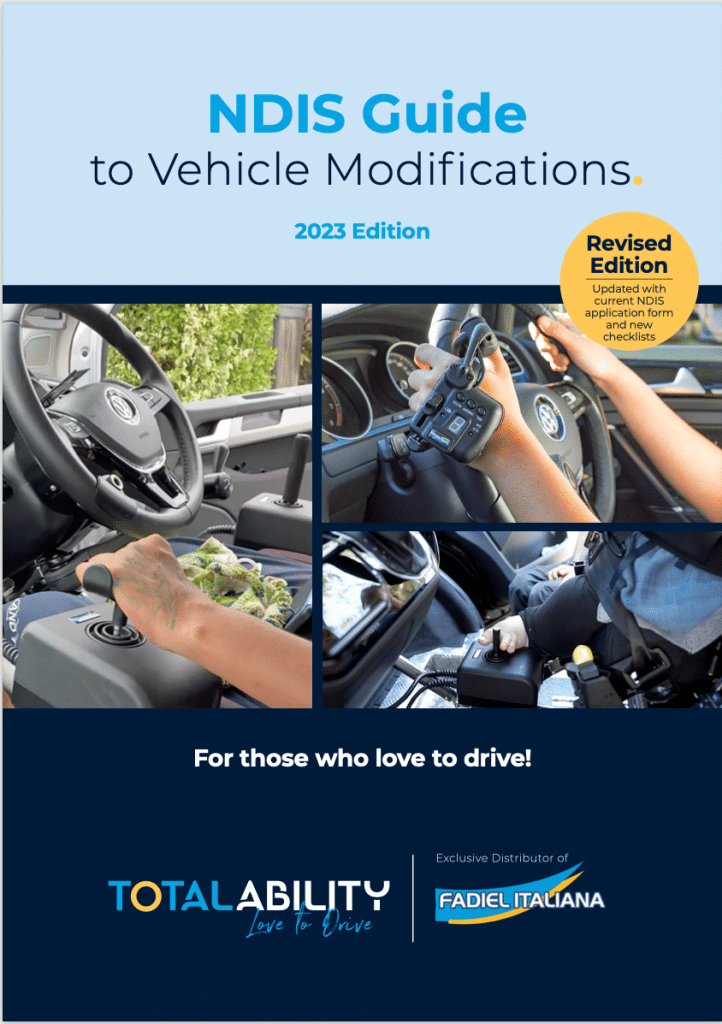
Total Ability Guide covers:
- Initial Assessment
- Understanding the Plan
- Assistive Technology & NDIS
- State Motoring Authorities
- Assessment Considerations
- Quotes and Evidence
- High-cost Vehicle Modifications
- The NDIS Application
- After Lodgement
- Checklists

Total Ability Catalogue with:
- Total Ability's range of driving hand controls
- For each control, the disabilities and conditions they are suitable for
- A comparison chart outlining the benefits and features of the various types of hand controls
- History of Fadiel Italiana and driving / access equipment


